
 English
 فارسی
فارسی 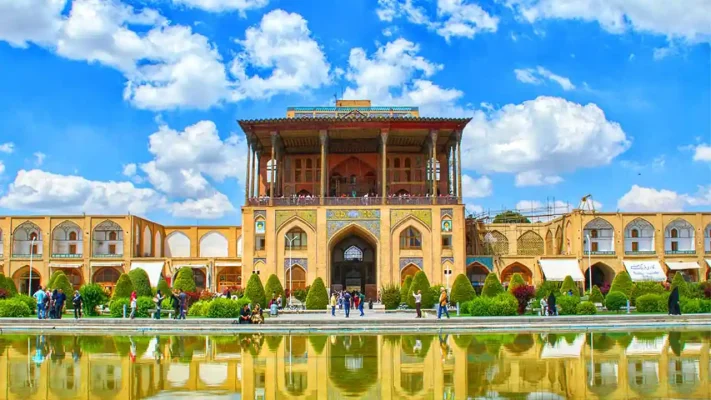

- The city of Isfahan is known to half the world, and it is not without reason that it is named after it. Another magnificent building in Isfahan is the Ali Qapu Palace, a 48-meter-high palace that was a marvel to the 17th-century viewer. In the past, due to the lack of tall buildings, the first thing that attracted the attention of travelers and merchants upon entering the city of Isfahan was the Palace of Shah Abbas I, or the Ali Qapu Palace. This palace is located to the west of the square and facing Sheikh Lotfollah Mosque
- But why the name Ali Qapu? In fact, Ali Qapu is a Turkish name, where Qapu means door and Ali means great and great, and in Turkish, it means great and great door. It is said that Shah Abbas brought one of the doors of Najaf to Isfahan because of his . devotion to Imam Ali and made it the entrance door. Currently, the door of the Ali Qachu Palace can be seen, the main door facing Naqsh-e Jahan Square. The public and historical entrance of the palace is the door behind the palace (facing the Safavid State Palace). A secondary entrance that is rarely used today.
- At the time, Ali Qapu Palace was a unique example of Safavid palace architecture, where the Safavid Shah received ambassadors and dignitaries in this palace. This building was completed and expanded over 5 architectural phases during the reign of Shah Abbas II and Shah Suleiman, between 70 and 100 years. Shah Abbas I had a three-story palace, and later during the reign of his successors, additional floors were added.
- Due to architectural additions and extensions, it has a different view on each side, so that from the front of the building, facing Naqsh-e Jahan Square, there are 2 floors, from the back of the building, there are 5 floors, from the sides of the building, there are 3 floors, and including the ground floor as the first floor, there are 6 floors in total.
- There are 18 columns on the Third floor, which had mirror and stucco decorations during that period. There is also a beautiful copper basin in the middle of it, which, in addition to its beauty, also enhances the beautiful ceiling of the porch. On the third floor, the Shah sat on the veranda and watched the ceremonies, polo games, celebrations, etc., and in its ceremonial hall, foreign and Iranian guests were received and meetings were held there..
- The fourth floor was the Shah’s harem, and a number of women who were interested in politics sat in small windows that looked down on the lower floor and were called earrings and listened to the words of the courtiers and meetings.
- The sixth floor of the palace is also one of the beautiful parts of the palace where the art of tangbari was used.
- This beautiful palace is located on the western side of the square and opposite the Sheikh Lotfollah Mosque. In examining the architecture of the Ali Qapu Palace in Isfahan, one of the most important points that stands out is the role assigned to each floor.
- The different functions attributed to each floor clearly show how a multifunctional building was created from a combination of diverse uses. The floors of the Ali Qapu Palace can be divided into three sections: public, private, and supplies. The first floor, as the entrance to the palace, was part of the public part and different people could access it.
- Muqarnas, brick facades, geometric paintings of flowers and plants, seven-color tiles with geometric patterns and cluster decorations are the most important decorative elements of the Ali Qapu mansion, which are beautifully combined with the taste and art of Master Reza Abbasi.
- There are three sets of stairs in the palace, two spiral staircases and a royal staircase that continues to the 3rd floor and does not exist to access the other floors.
- Isfahan is an ancient city with a beating heart of culture, art and architecture. Every corner of it has a story and every building has kept a part of history. Among all the magnificent manifestations of this city, “Ali Qapu” has a special place. The palace, which shines like a jewel in the middle of Naqsh-e Jahan Square, showcases the splendor of the Safavid era. If you are planning to travel to Isfahan, you will have the best experience of Isfahan with Zhiva Parvaz Agency.
0 Comment