
 English
 فارسی
فارسی 

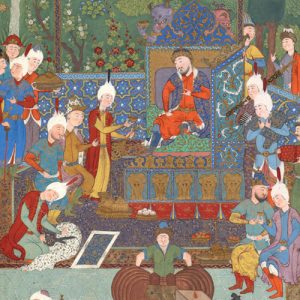
Jam or Jamshid in Avestan is one of the greatest kings of ancient Iran. His name is mentioned in the Avesta, Pahlavi writings, and writings from the Islamic period. In Iranian history, many significant achievements are attributed to him. In the Shahnameh, Jamshid is the son of Tahmuras and a glorious king who ultimately loses the divine glory due to his self-importance and pride, and is killed by Zahhak. According to the Vendidad, he is the first person to acquire esoteric wisdom and In the culture of the Avesta vocabulary, the following is mentioned about the name Jamshid:
“Jamshid: The era of brilliance and radiance of the Aryans’ life. The time of Jamshid was when people achieved the making of bricks and the construction of porches and baths and cities, pottery and vessels, weaving and spinning silk, linen, and cotton, extracting gems from the heart of stones, building ships, and perfumes and wine…”was able to establish the epistemological system of Iran. And when the enjoyment of that era reached its peak, the tyranny of the Babylonians (Zahhak) overshadowed the happy days of the Aryans, and Jamshid or the Aryan land was divided in two by Aži Dahāka, and the Zahhakians (Babylonians) ruled over the land of Iran for a thousand years with oppression, burning, and killing.
Mythologies about the seven wonders that Jamshid created and Alexander destroyed are very popular among the Persians. This legend is well-known in both prose and verse in several manuscripts at the National Library of Paris.
The Seven Wonders of Jamshid
The seven wonders are:
A lamp that burned without oil.
A bird… that did not cast a shadow from the sun.
A lute… with a lapis lazuli neck and four strings; when you blew on it, it sounded like a lute, and if someone had a tremor, you would hear the lute’s sound, the tremor would cease.
Golden flies that were flying, if someone had eaten a pomegranate, you would have heard the song of the flies, and the poison would have left him.
A pitcher… that you poured in the feast, there were a hundred men, and for each man, you made a wine of every color in that pitcher.
A river of water… and in the midst of the water, an arch, and within the arch, a platform, and on the platform, a statue resembling a great judge seated. If two people had enmity (hostility, disagreement) with each other, they would present their case before the statue; the one who lied would sink beneath the water, while the one who spoke the truth would rise above the water before the judge.
A dome, half white and half black, so that if someone passed from the world and their soul appeared on the fourth dome at night, if it was on the white half, they were heavenly. If it was on the black half, they were damned (infidel, non-believer), meaning they were hellish
The title of Jamshid among the Iranian kings
Many Iranian kings even in the periods after Islam gave themselves the titles of Jam-Jah, Jamshid Jah, and Jam Iqtidar. These titles were more common among the kings of the Safavid and Qajar periods. Even Naser al-Din Shah, imitating the throne of the Jameh Jamshid citadel, had a very expensive marble throne made, which is now located in the Golestan Palace in the Arg Square (15 Khordad Square) in Tehran.
0 Comment